

Modern desk with laptop displaying financial charts, paperwork, and coffee mug - representing tax planning and strategic business deductions.
The OBBBA has restored and expanded some of the most powerful tax breaks available to business owners - including permanent 100% bonus depreciation, bigger Section 179 expensing, and new deductions for production property. From equipment and vehicles to rental real estate, these changes could unlock massive first-year write-offs for 2025 and beyond.
In short, the One Big Beautiful Bill Act just changed the game. With 100% bonus depreciation made permanent, Section 179 limits more than doubled, and new opportunities for manufacturers through qualified production property, there are major ways to lower your tax bill in 2025 and beyond.
Here’s what you need to know to take advantage.
100% Bonus Depreciation Returns (and Stays)
Starting January 20, 2025, businesses can once again claim 100% bonus depreciation on qualifying property.
Unlike the temporary rules we saw from 2018–2022, this time the deduction is permanent.
Any tangible property with a useful life of 20 years or less qualifies - including equipment, off-the-shelf software, and even land improvements like driveways, landscaping, or fencing.
Interior improvements to non-residential buildings (e.g., retail or office renovations) also qualify.
Translation: if you invest in your business, you may be able to write off the entire cost in year one.
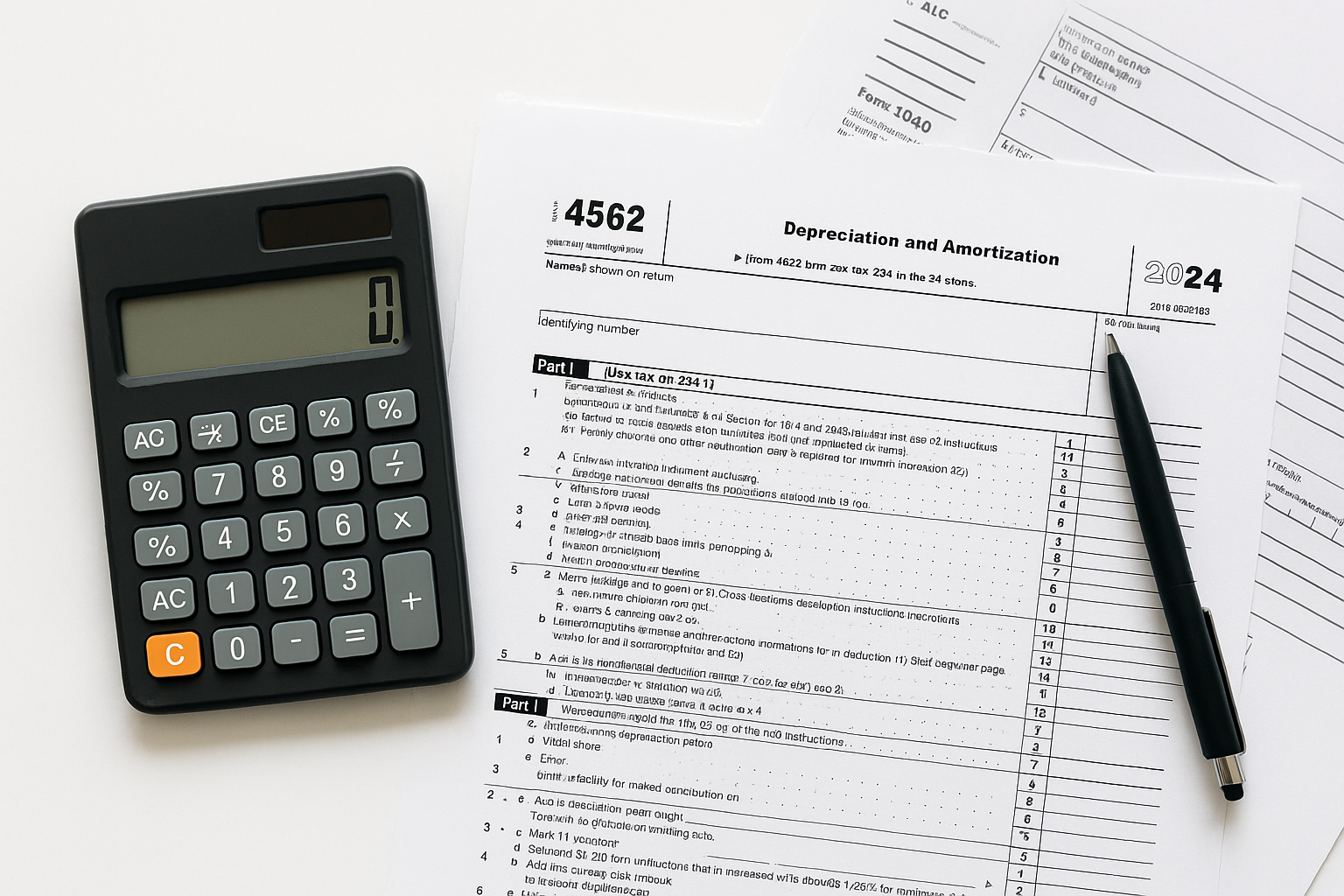
Calculator and IRS Form 4562 Depreciation and Amortization with a pen - illustrating bonus depreciation and Section 179 tax deductions.
What Doesn’t Qualify
You can’t use bonus depreciation for:
Land
Permanent structures (like buildings)
Inventory
Intangible property (patents, copyrights, trademarks)
Property outside the U.S.
Limits on Bonus Depreciation
Some restrictions apply:
Passenger vehicles → capped at an $8,000 annual bonus deduction, with a total first-year cap of $20,200.
Heavy vehicles over 6,000 lbs → no cap, so 100% of the cost can be deducted if used fully for business.
You must use bonus depreciation for all assets in the same class purchased that year (no cherry-picking).
Big Win for Real Estate Investors
Owners of commercial and residential rental property benefit too:
With cost segregation studies, you can break out personal property (like fixtures, equipment, and land improvements) from the building itself.
These items often qualify for faster depreciation - now boosted by the OBBBA’s 100% rule.
For many projects, 20–30% of the total cost may be eligible for first-year write-offs.
Planning tip: If you’re considering a cost segregation study, schedule it early - demand will spike with this change.
Section 179 Expensing: Higher Limits, More Flexibility
The OBBBA also expanded Section 179 expensing:
Deduction limit increased to $2.5 million (up from $1.22M in 2024).
Begins phasing out when total qualifying purchases exceed $4 million.
Fully phased out at $6.5 million.
Like bonus depreciation, Section 179 covers tangible personal property, off-the-shelf software, and non-structural improvements. But unlike bonus depreciation, Section 179 can also apply to roofs, HVAC systems, and certain exterior improvements.
Section 179 vs. Bonus Depreciation - Which Should You Use?
Both provisions allow accelerated deductions, but there are key differences:
Recapture: Section 179 deductions must be recaptured (paid back) if business use drops below 50%. Bonus depreciation generally avoids this (except vehicles).
Income Limits: Section 179 deductions can’t exceed taxable business income for the year. Bonus depreciation isn’t capped this way.
Flexibility: With Section 179, you can pick and choose assets. Bonus depreciation requires applying to all assets in the same class.
Automatic vs. Elective: Bonus depreciation applies automatically unless you elect out. Section 179 must be claimed explicitly on your return.
Want to know which strategy fits your business? Contact Brothers Tax today and we’ll map out the best play for 2025.
New 100% Deduction for Qualified Production Property
The OBBBA introduced a brand-new opportunity:
Businesses can deduct 100% of the cost of constructing or purchasing qualified production property (factories, refining halls, assembly lines, and other non-residential structures tied to manufacturing).
Applies to property built or acquired between Jan 20, 2025 - Dec 31, 2028, and placed in service before Jan 1, 2031.
If sold or used for fewer than 10 years, the deduction may be recaptured.
This is a powerful tool for manufacturing businesses planning expansions or upgrades.
Key Takeaways for Business Owners
100% bonus depreciation is back - permanently.
Section 179 limits have more than doubled, creating flexibility for mid-size businesses.
Real estate investors can combine cost segregation with bonus depreciation for massive first-year deductions.
Manufacturers get a unique opportunity with the new Qualified Production Property deduction.

3D financial growth chart symbolizing increased tax savings and business growth through 2025 deductions.
Next Step: Talk to Brothers Tax Firm before year-end to map out which investments you can make now to maximize these deductions.